Source
Instrument or event: kick, cello, room tone, footsteps, machine hit, riser, vocal phrase.
Search “metallic impact with a long dark tail,” “70s dry snare,” or “124 BPM synth loop in F minor.” Sample understands details like tempo and key while still listening for mood and texture.
Sample can only find what exists in your library. Your ears make the final call.
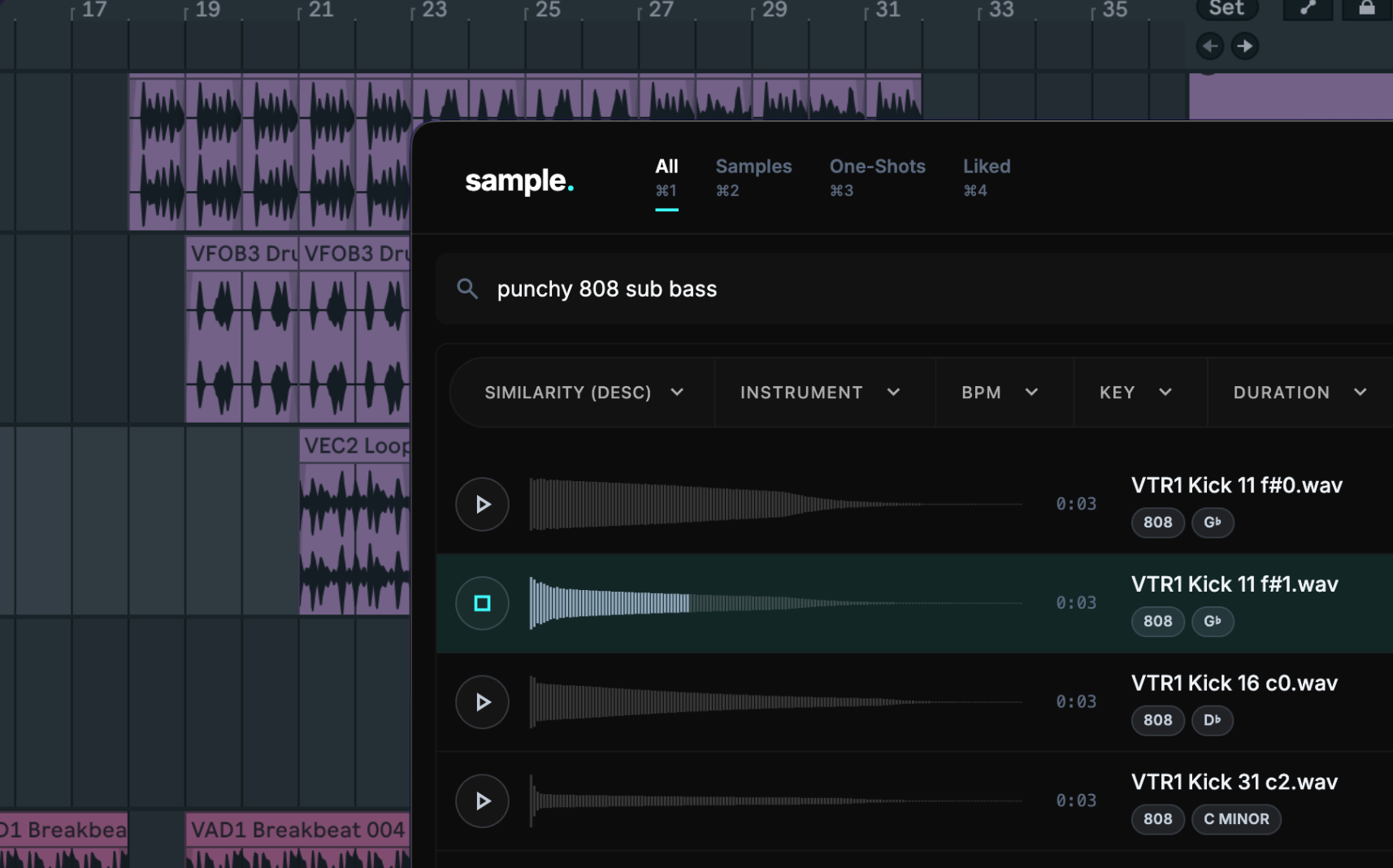
Strong queries do not need every category. Start with the property you can hear most clearly.
Instrument or event: kick, cello, room tone, footsteps, machine hit, riser, vocal phrase.
Warm, brittle, close, wide, dusty, hollow, wet, intimate, unstable, saturated, restrained.
Explicit BPM, BPM ranges, key, mode, loop versus one-shot, or a request to preserve tempo/key around a reference.
More organic, less bright, shorter, heavier, softer, or between two known reference sounds.
Use whatever you have: a filename, a feeling, a musical role, or one reference that is almost right.
| What you remember | Best query | Why |
|---|---|---|
| The exact file | kshmr_clap_017 | Go straight to the name you remember. |
| The sound, not the name | tight layered clap with a bright room | Let the audio—not the filename—carry the meaning. |
| The musical slot | 124 BPM bass loop in F minor | Bring the arrangement into the search. |
| A close reference | Find similar → more organic → keep BPM | Start close and steer with your ears. |
If results are vague, add one discriminating property—not a paragraph of conflicting adjectives.
“Percussion” is wide. “Metallic hand percussion hit” removes entire irrelevant families.
“With a papery attack” is more discriminating than five generic mood words.
Add BPM or key when your arrangement requires it. Do not over-constrain one-shots with metadata that may not apply.
A strong query is a hypothesis, not a commandment. Audition the top results, then switch to a reference-led search when one candidate is close enough to express the target more precisely than another sentence.
Sample searches and analyzes locally on Apple Silicon and Intel Macs. Your audio stays on your Mac. Use it offline after activation, drag results into any DAW, and request a refund within 14 days if it does not improve your workflow.